
smarken blog

Digital Sovrignty, Privacy, EU Law & Legislation, IT, Linux

AI - LLM

AI - LLM

NB John Nielsen har lavet en artikel om samme sag.

LTT video:

Transcript behandlet i mistral: Her er teksten delt op i pæne afsnit og let redigeret, så overgangslyde og transcript-markeringer (">>", gentagelser osv.) er ryddet væk:


En AI-klon af Photoshop vækker opsigt

So, I'm lying in bed last night and my phone absolutely blows up with everyone talking about the same thing: there's an AI clone of Photoshop that is basically feature complete, costs $70 one time, and works across Windows, Mac, and Linux.

My initial reaction was: yeah, sure, I've heard that before. But then I dug a little deeper, and my whole perspective changed. This isn't another basic "Claude, make me my own version of Photoshop with some basic tools X, Y, and Z." And it's not just Photoshop. Through what appears to be a combination of decompiling original applications and straight-up vibe coding, we're seeing projects as diverse as free clones of the entire Adobe Creative Suite to game mashups — where you can rip around on a skateboard in Modern Warfare 2, or play a hardcore Tarkov-style extraction shooter in the world of Skyrim.

Piracy eller fremskridt?

Naturally, this has resulted in an eruption of opinions. Some have been quick to condemn it as piracy, while others have called it a natural step in the evolution towards a future where paid proprietary software is dead and AI-assisted open source reigns supreme. What everyone agrees on, though, is that nothing will ever be the same again.

However, I feel like we might have skipped over an important point here. However this software is made — whatever the moral, ethical, and legal ramifications — none of this matters if these apps are not usable. I mean, Lord knows they're not likely to be maintained. So, I did the right thing and bought the $70 Photoshop clone everyone's talking about.

Wait — it's free now, as of filming. That changed in the last three hours. That's how fast things are moving right now. And the point is: free or $70, I tasked some of our professional users with trying to use this software. And whoa.

Første indtryk hos vores testere

"Oh, that's very slow to open. Just importing the images took a lot longer than usual. With Photoshop it's pretty much instant — this actually had to take a second to load. It seems like Photoshop is a little more well-tuned, right from the get-go."

"Immediately — I've been using this for 5 seconds — it is good enough for me to not notice an immediate difference. The menus… are they supposed to be just like Photoshop's? They seem very similar, if not the same."

"We're getting all sorts of errors. Game over. As someone who would be doing this professionally, having to wait this long for every tweak? I just wouldn't use it."

Hvordan laver man den slags software?

The first question that's got to be on your mind is: what is happening here? There are two main ways to build this kind of clone software.

The first, and the most complete, is decompilation. You take the binary code — the ones and zeros that run on your machine — and turn it back into the kind of human-readable source code that the original developer used. It won't be exactly the same code, but if it swims like a duck and quacks like a duck, it is, for all user purposes, a duck.

Traditionally, decompilation has been extremely labor-intensive and tedious, which made it only make sense for very small projects, very important projects, or very obsessed developers. But AI has completely changed the game. You can tell your AI: "Take this gobbledegook of ones and zeros, of machine instructions with no comments, and turn it back into the source code that created it" — and it'll churn away on it surprisingly effectively, for as long as your bank account allows before it's drained of credits.

It's worth noting, though, that not all types of decompilation are the same. Kingy has a great blog post outlining the different kinds of things we call decompilation, and it's arguable that what Photon Studio is using is probably closer to functional reconstruction — where the new AI-generated source is intended to reproduce the same behavior as the original software, but has completely different bytes from the original source code. So really, it's more like AI slop with an original program as part of the input.

Test af de avancerede funktioner

"We got object selection, quick selection, magic wand… finding objects. That's the one I want. That worked pretty good."

"I usually don't rely on 'select subject' to do the crop 100%, but it gives a good starting point. I'd say that did a pretty good job — it lost the hat a little bit. Photoshop did a lot better with the hat. Right off the hop, Photoshop's automatic selection is so much cleaner. This requires almost no work from me on the Photoshop side; on the other one, a lot of work."

"That is literally the only reason I have subscribed to Photoshop: cutting out subjects from the background."

There were oddities, too: when selecting a subject, the clone grabbed parts of the image underneath the selected layer — something Photoshop doesn't do. RAW editing also fell short: raising shadows with the dedicated slider didn't come anywhere near what Photoshop's exposure adjustment alone could do, and the color mixer either wasn't working or was taking forever to update its preview. Layer moves showed the position updating while the image itself lagged behind, and right-clicks froze the app entirely.

Er det overhovedet lovligt?

Okay, so your next question's got to be: well, this is illegal, right? Maybe, maybe not.

One of the most interesting cases of software reverse engineering didn't even involve decompilation. I'm talking about the time Phoenix Software kicked off the affordable clone-PC revolution by creating an IBM-compatible BIOS without infringing on any of IBM's original source code. They did this by painstakingly studying and documenting the source listings in the IBM PC technical reference manual, then tasking a separate engineer — who had never read the original — with creating their own code that mimicked the APIs. Notably, this was deemed legal because the engineer who wrote it had never seen the source code, and therefore couldn't have stolen it.

Legal carve-outs for reverse engineering software remain to this day. Could that apply here? In the Phoenix case, it didn't matter how similar the result was to the original code, if the writer had never seen it. And the AI has never seen the original source code — at least, not that the data aggregators who created it would ever admit. But patent and copyright law can apply to functions and ideas as well, and all of this varies from one jurisdiction to another anyway. At best, we're in very murky waters.

Konklusion: "I can't believe it's not Photoshop"

So, now that our testers had fiddled with Photoshop and "not-Photoshop" — overall impressions?

"A lot more similar than what I was expecting. 'I Can't Believe It's Not Photoshop' is a good label."

"Hey man, if you want to do Photoshop stuff and you ain't got no money — this is a great alternative."

"I hate how much Photoshop costs. I've been trying Affinity, I've been trying Photomator. When I saw these popping up, I was like: maybe this is it. This one looks really nice — but I feel like it needs a year of tweaks."

Probably the biggest thing to keep in mind in all of this: while we focused on Photon Studio for our own selfish purposes — I hate giving Adobe money as much as anyone, and I would love a $70, excuse me, free alternative — there are numerous other similar projects, some individual efforts, some from groups attempting to do the same thing. Notably, the reaction to them has been more receptive than I expected, given the generally anti-AI stance of the creative community.

It's clear, then, that Adobe's memeworthy quality and ruthless subscription-only model has done enough to antagonize their customers that numerous creators are looking for the exit — even if that means being driven into the arms of Big AI. This is not financial advice, and I probably won't do it, but let me put it this way: I asked my wife today if she knows how to short a stock.


Original rtranscript (via youtube-transcript.io)

So, I'm lying in bed last night and my phone absolutely blows up with everyone talking about the same thing. >> There's an AI clone of Photoshop that is basically feature complete, cost $70 one time, and works across Windows, Mac, and Linux. >> Initial reaction, yeah, sure, I've heard that before. But then I dug a little deeper and my whole perspective changed. This isn't another basic Claude, make me my own version of Photoshop with, I don't know, some basic tools X, Y, and Z. And it's not just Photoshop. Through what appears to be a combination of decompiling original applications and straightup vibe coding, we're seeing projects as diverse as free clones of the entire Adobe Creative Suite to game mashups where you can like rip around on a skateboard in Modern Warfare 2 or play a hardcore Tarov style extraction shooter in the world of Skyrim. Naturally, this has resulted in an eruption of opinions. Exactly. Some have been quick to condemn it as piracy, while others have called it a natural step in the evolution towards a future where paid proprietary software is dead and AI assisted opensource reigns supreme. What everyone agrees on though is that nothing will ever be the same again. However, I feel like we might have skipped over an important point here. However this software is made, whatever the moral, ethical, and legal ramifications, none of this matters if these apps are not usable. I mean, Lord knows they're not likely to be maintained. So, I did the right thing and I bought the $70 Photoshop clone that everyone's talking about. Wait, it's free now as of filming. That changed in the last three hours. That's how fast things are moving right now. And the point is, free or $70. I tasked some of our professional users with trying to use this software and whoa. Hopefully that's just a bug >> immediately. It is good enough for me. >> We're getting all sorts of errors. >> Game over. Like there's I just I wouldn't use it. >> Enjoy. Also enjoy the segue to our sponsor. >> Threat Locker. They make adopting a zero trust framework easier for businesses to navigate and their flagship event Zero Trust World is coming in February. Learn more about Zero Trust World and secure your tickets with the link below. >> Oh, that's very slow to open. Just importing the images in that took a lot longer than usual. Like with Photoshop, it is pretty much instant. This actually had to take a second to load. It seems like Photoshop is a little more welltuned, I would say, right from the get- go. >> Okay, this one just straight up doesn't open. Okay, well, I guess I got to do the the kimono dragon instead. Immediately, I've been using this for 5 seconds, but immediately it is good enough for me to not notice an immediate difference. >> So, the menus, are the menus supposed to be just like Photoshop 2? They seem very similar, if not the same. >> The first question that's got to be on your mind is what is happening here? And there's two main ways to build this kind of clone software. The first and the most complete is decompilation. In this case, you take the binary code, the ones and zeros that run on your machine, and you turn that back into the kind of human readable source code that the original developer used. It won't be exactly the same code, but if it swims like a duck and quacks like a duck, it is for all user purposes a duck. This is so weird. >> Let's give him Terren's eyes. >> Terren's eyes. You know what? This doesn't have to be a perfect job. Oh god, what have we done? What have I done? Dude, this is so cursed. >> It's Italic. Cut out Llin as his head. >> There we go. >> Perfect. >> Oh, there we go. >> Wow. >> Oh, wait. Wait. Where's his eyes? Oh, no. This is not a tearing tongue. Now decompilation traditionally has been extremely labor intensive and tedious making it only make sense for very small projects, very important projects or very obsessed developers. But AI has completely changed the game here. You can tell your AI, hey, take this gobbledegook of zero and one machine instructions with no comments and then try and turn it back into the source code that created it. and it'll sit and churn away on it surprisingly effectively for as long as your bank account allows before it's drained from all the credits you're consuming. It's worth noting though that not all types of decompilation are the same. Kingy has a great blog post outlining some of the different kinds of things that we call decompilation and it's arguable that what photon studio is using is probably closer to functional reconstruction where the new AI generated source is intended to reproduce the same behavior as the original software but has completely different bites from the original source code. So really, it's more like AI slop with an original program as part of the input. >> We got object selection, quick selection, magic wand. Finding objects. That's the one I want. That worked pretty good. >> Usually don't rely on the select subject to do the crop 100%, but it usually gives like a good starting point. And I'd say that did a pretty good job. It lost the hat a little bit. Yeah, Photoshop did a lot better with the hat. I will say right off the hop the Photoshop like automatic selection so much cleaner. Like this requires like almost no work from me on the Photoshop side. On the other one a lot of work. >> That is literally the only reason that I have subscribed to Photoshop is for cutting out subjects from the background. >> Okay, that that's interesting. When you do the select subject or whatever, uh it'll usually just do like whatever layer you have selected. This one has grabbed some of the image underneath, which I don't at least I don't remember Photoshop doing that. Okay, so your next question's got to be, well, this is illegal, right? Well, maybe, maybe not. One of the most interesting cases of software reverse engineering to me right now didn't involve decompilation. I'm talking about the time that Phoenix Software kicked off the affordable clone PC revolution by creating an IBM compatible BIOS without infringing on any of IBM's original source code. They did this by painstakingly studying and documenting the source listings in the IBM PC technical reference manual, then tasking a separate engineer who had never read the original with creating their own code that mimicked the APIs. Notably, this was deemed to be legal because the engineer who wrote it had never seen the source code and therefore couldn't have stolen it. And legal carveouts for reverse engineering software do remain to this day. Could that apply here? It was found in that case that it didn't matter how similar the result was to the original code if the writer had never seen it. And well, the AI has never seen the original source code. At least not that the data aggregators who created it would ever admit. But then also patent and copyright law can apply to functions and ideas and all of this varies from one jurisdiction to another anyway. So at best we're in very murky waters right now. So Ree, you discovered something super interesting about this. When you were raising and lowering the exposure dial. >> Yeah, >> cuz these are both taken in RAW. You should be able to bring up the shadows just like this. >> Yeah. So, if I if I try to do it even there, even if I use the shadows uh slider, it doesn't even bring up the shadows anywhere near where the even just the exposure on Photoshop can can do. >> It's got a color mixer that's always uh extremely handy. >> Yeah. Is that grabbing the correct colors that you expect it to grab? >> It's either not doing it or it's taking forever. Updating preview down here. So, doesn't seem like the color mixer is working that well. Uh Whoa, that's okay. I'm guessing hopefully that's just a bug. So, like this. I'm selecting my face layer right now. I'm There we go. I'm moving it around. It is moving the position of the image, but the actual image itself is not updating. It's like lagging behind. Wow, that was crazy lag. I right clicked and it just was a while until it click. I' I've clicked. I've rightc clicked. There it is. as like someone who would be doing this professionally having to wait this long for every tweak. Game over. Like there's I just I wouldn't use it. >> Okay, so now that you fiddled with Photoshop and not Photoshop overall impressions >> a lot more similar than what I was expecting. Uh and I mean I I think the I can't believe it's not Photoshop is a is a good label. >> Hey man, if you want to want to do Photoshop stuff and you know you ain't got no money. >> No, I think this is a great alternative. >> Yeah. Yeah, >> I hate how much Photoshop costs. I've been trying Affinity. I've been trying Photomator. When I saw these popping up, I was like, maybe this is it. But this this one here, well, it looks really nice. Maybe it I feel like it needs like a year of tweaks. Probably the biggest thing to keep in mind in all of this is that while we decided to focus on Photon Studio for our own selfish purposes, I hate giving Adobe money as much as anyone, and I would love a $70, excuse me, free alternative. There are numerous other similar projects. some individual efforts, some from groups that are attempting to do the same thing. And notably, the reaction to them has been more receptive than I expected given the generally anti-AII stance of the creative community. It's clear then that Adobee's memeworthy quality and ruthless subscription only model has done enough to antagonize their customer group that numerous creators are looking for the exit, even if that means they're going to be driven into the arms of big AI. This is not financial advice and I probably won't do it, but let me put it this way. I asked my wife today if she knows how to short a stock. Now for a short segue to our sponsor, >> Threat Locker. With AI deploying into workplace, new vulnerabilities and exploits being discovered daily, and the speed at which cyber security landscape is changing, it's important to continue to stay on top of how you can keep your business secure. At Zero Trust World, Threat Locker's flagship event, there will be hands-on labs, deep dives into today's most pressing topics, and plenty of opportunities to connect and learn from other cyber security professionals. We've gotten to attend and speak at zero trustworld and the conference continues to grow every year. The sessions are eligible for continuing education credits and attendees will leave with the knowledge and skills to implement zero trust in their organization or get firstirhand experience at a hacking lab going to see how exploits work and how to prevent them. Learn more about zero trust world and secure your tickets with the link in the description. The afterparty is one you don't want to miss. >> You guys enjoyed this video? Why not check out the last time we looked at how much we're paying Adobe and tried to find an alternative? It was a while ago, but it was tough.
“They need trillions of dollars in revenue. Who’s going to pay it?”

Senior Distinguished Fellow at the Center for Economic and Policy Research Dean Baker joins The Tech Report’s Isaac Pound to talk about how some of the founding principles of the AI industry are now in question after business leaders admit they’re not using frontier models.

Comments:

@teamspeak9374 for 18 timer siden On one side you got highly credited independent economists, journalists and researchers saying the economics makes no sense. On the other side you have a bunch of tech bros saying to close your eyes to reality cause AI will fix it. I wonder who's more credible 🤔 579 Svar 71 svar @15tt-b3h for 17 timer siden This will be the third major global economic bubble to affect my adult life. What a time to be alive! 343 Svar 36 svar @joemclemore3503 for 17 timer siden It will be a cold day in hell when I turn over any of my personal dealings the Meta's "agent" muse. It's malware/spyware on freakin' steroids. 193 Svar 8 svar @arandmorgan for 15 timer siden Do you mean, due to their extreme wealth and power they suffered so much from the isolation away from normal people, that their disconnect led to them providing a service or product that nobody wants. Who could have thought that? 37 Svar 2 svar @georgemcbay for 12 timer siden Mike Ehrmantraut from Breaking Bad knows a lot about the economics of AI. 12 Svar @tomryan3012 for 18 timer siden Salesforce bet the company on their AI product ‘Agentforce’, they were even going to rename Salesforce to Agentforce. It failed so badly that they’ve backtracked and teamed up with Anthropic, rebranding to AIforce.

Internally, salespeople are struggling to sell AI tooling. Credit consumption models are a CFO’s nightmare

https://invidious.nerdvpn.de/watch?v=l6ZcFa8pybE https://www.youtube.com/watch?v=l6ZcFa8pybE

How did we go from digital computers to AI seemingly everywhere? Neil deGrasse Tyson, Chuck Nice, & Gary O’Reilly dive into the mechanics of thinking, how AI got its start, and what deep learning really means with cognitive and computer scientist, Nobel Laureate, and one of the architects of AI, Geoffrey Hinton.

Hinton explains the fundamental shift from logic-based rule programming to the biological approach: building systems that learn the way a brain does. Learn about the history of computer science that led to the breakthroughs we have today. We break down the structure of artificial neural networks and the meaning of AI buzzwords like “deep learning” really mean. You’ll learn about the layering of data processing and how the first layer of neurons might detect a simple edge, the second a beak, and the third a bird’s head.

Hinton explains the light bulb moment of backpropagation, the mathematical breakthrough using calculus to send force backward to strengthen previous connections. Is this a process we share with neural nets? We discuss whether AI thinks like us and explore why AlphaGo succeeded in beating us at our own game by generating its own data and whether LLMs will hit a ceiling as they run out of human-written text. Can AI reason? What does it mean for something or someone to think?

As the science turns toward the future, we tackle heavy questions regarding the massive energy demands of data centers and whether AI can reinvent solar technology to save itself. Hinton discusses the "Volkswagen Effect," where a model might strategically underperform to avoid being unplugged. We dive into consciousness to ask if subjective experience is just a byproduct of complex perception and if chatbots already possess it. What are the upsides as well as the downsides? The singularity isn’t imminent yet... but the "yet" is doing a lot of heavy lifting.

Thanks to our Patrons Kylie Jonasson, Bryan Pfeifer, Anton Couzens, Brad Smith, Jeffdrumseitz, Richard Vaughan, sSHEScience©, Ben Mondoux, Julien Ballez, Tom, Matteo Berlanda, Dr. Cool Young Booger Results Murray, Shawndra Hill, Mike Easter, Charles Shields, Xander-Tony Kehr, Chase Busha, Leah, Justin Harris, Stephen Schultz, Jason West, ImaPerson, Argie Weatherington, Ted Barnett, MD, Lizzie O'Grady, Kimja, Paul Baltatescu, Hanna Cantley, Bill Hoffman, FreddieAbdon, Trish, Muath, Timeless Angel, Dxly, Michael Fuery, Tom Hadrava, Guy Eran, Max Murphy, Cristy Nourash, Donita Buchheit, Kel, Screaming Firehawk, Patricia Churchland, Mikael Stenberg, Dale Duncan, Ghostpacho, Nathan Lehenbauer, James Schaedler, Andrew G, Samuel Sladkovský, Punished Leno, Chris L, George Papura, Miguel Basto, Brittney Starkey, David Rouisse, WTFbro Podcast, Marvin, Jason Driscoll, Yasyoc, Donte Jones, Trevor, Andrew, Jared Harrison, Terence Garrod, TheCrassDragon, Daithon Brown, Perkins, Brendan Gost, Daria Shkrabachenko, Tania Cortes Alonso, JD, Jacob Westman, Lacey Rae Castleberry, Isaac Castrillo, Eric Bouliane, Tim The Secular Humanist, João Sampaio, Aegor, Evan Schreier, Amanda Burris, Allen Arthur, Vikas Jain, Jeroen Wilms, Nathan Schepker, Sverre Moe, Ruth Crisp, Legend Omega, B Dubbz, Jay Youmans, Nite Stalker, Adrian Hungate, Marguerite Nesfield, Michael Engelman, Scott Donner, Diamir Elliott, Warsame Giuled, Kansas Dan, Rey Pierantoni, and Rick Servello for supporting us this week.

Timestamps: 00:00 - Introduction: Geoffrey Hinton 03:00 - Approaches to Make and Intelligent System 07:19 - How Artificial Neural Nets Work 14:12 - Making a Neural Net By Hand 24:41 - Backpropigation Breakthrough 33:44 - Why AI Seemed to Arrive So Fast 34:39 - What is Thinking? 37:50 - Is AI Better at Learning? 47:41 - Can We Humanize AI? 50:58 - Setting Up Guardrails 54:04 - Is AI Lying to Us? 58:47 - Will AI Be the End of Us All? 01:00:51 - Does AI Hallucinate? 01:04:36 - The Upside 01:08:13 - Will AI Create More AI? 01:10:17 - AI Nuclear Winter: Will We Unite? 01:15:10 - 2024 Nobel Prize in Physics 01:16:44 - The Price of Replacing All the Jobs 01:22:50 - Achieving Consciousness 01:28:37 - The Work to Be Done Before the Singularity

Check out our second channel, @StarTalkPlus

Get the NEW StarTalk book, 'To Infinity and Beyond: A Journey of Cosmic Discovery' on Amazon: https://amzn.to/3PL0NFn Support us on Patreon: / startalkradio

FOLLOW or SUBSCRIBE to StarTalk: Twitter: / startalkradio
Facebook: / startalk
Instagram: / startalk

StarTalk #NeildeGrasseTyson

https://mastodon.social/@smarken/117304123745580295

Et nyt udkast til AI-hjemmelsloven er i høring frem til 5. oktober. Det giver offentlige myndigheder hjemmel til at bruge AI som beslutningsstøtte, men ikke til automatiske afgørelser.

Da jeg læste det, blev jeg mindet om et citat, Jacob Haugaard gav fra Folketingets talerstol i 1995: "Min personlige opfattelse er, at jeg må stå over for sådan en flok halvuvederhæftige lystløgnere."

Jeg vil ikke kalde nogen lystløgnere. Men lovforslaget hænger slet ikke sammen i praksis.

Udfordringen her er, at sagsbehandleren ifølge forslaget skal tage reel stilling til det forslag, AI-systemet kommer med.

Men ministeriet skriver selv, at kravet til den menneskelige involvering ikke er fastlagt klart. Logning og dokumentation af afvigelser nævnes i den forbindelse som gode redskaber, men de er ikke et krav.

Det er simpelthen for dårligt. Al erfaring viser at myndigheder gør det, de bliver pålagt - og ikke mere end det.

Selvfølgelig ikke. De har også en økonomi, der skal hænge sammen, og tekniske kontroller er dyre både at implementere og drifte.

Lad os antage, at lovforslaget går igennem. Hvad sker der så, når en afgørelse bliver påklaget og behandlet et halvt år senere?

Hvis der ikke er krav om logning, hvordan dokumenterer myndigheden så, at sagsbehandleren ikke bare kopierede AI-systemets forslag?

Min helt store anke er, at forslaget ser stort på al erfaring fra arbejdet med GDPR og NIS2... og den praktiske konsekvens deraf er at både kommunerne og styrelserne efterlades uden at vide, hvad der egentlig kræves af dem. Nåh ja, og at borgerne efterlades uden garantier for deres retssikkerhed. https://www.linkedin.com/feed/update/urn:li:share:7506394167342788608/

"Ex-OpenAI researcher Daniel Kokotajlo walked away from $2 million rather than stay silent, and now reveals why he believes there's a 70% chance AI leads to human extinction, why superintelligence could arrive before the end of the decade, and the one plan he thinks could still save us all! Daniel Kokotajlo is a former OpenAI researcher and one of the world's leading AI forecasters. He is the founder of the AI Futures Project and the lead author of 'AI 2027,’ the widely-read scenario mapping the trajectory of artificial intelligence. His follow-up, 'AI 2040: Plan A,’ sets out how the world could still navigate superintelligence safely. He explains: ■ What he saw inside OpenAI that made him walk away ■ Why the people building AI privately believe it's coming even sooner than the public is being told ■ What happens if AI becomes powerful enough that humans can no longer control it, and why he puts the odds of catastrophe as high as 70% ■ Why almost every job could be automated, and what that means for the next generation ■ The plan he believes could still lead to abundance and a future worth living in "

https://www.youtube.com/watch?v=_g4l7YkDQwA

En filippinsk kvinde, Maria, blev offer for digital kærlighedssvindel, da hun troede, hun havde indledt et forhold med Dubais kronprins, Hamdan bin Mohammed. Svindleren brugte en AI-genereret deepfake til at narre hende via live-videosamtaler og romantiske beskeder. Maria mistede sine opsparinger (ca. 17.600 DKK) til svindleren, der blandt andet krævede betaling for en falsk vielsesattest og et "kongeligt medlemskort". Sagen er del af et større mønster, hvor svindlere misbruger kronprinsens identitet og udnytter hans store tilstedeværelse på sociale medier. Forskere advarer om, at AI-teknologi gør svindlen stadig sværere at gennemskue, og at deepfake-videoer i realtid snart kan blive umulige at skelne fra ægte samtaler. Myndighederne i Dubai har endnu ikke kommenteret sagen.


Læs resten på Tjekdet https://www.tjekdet.dk/indsigt/maria-troede-dubais-kronprins-var-forelsket-i-hende

Resumé: Mythos/NSA-brudpåstanden – Hvad er egentlig bekræftet?


Kilde : https://thecybersecguru.com/news/mythos-nsa-breach-claim/


🔍 Hovedpåstanden og dens oprindelse

  • Kernen i nyheden stammer fra ét citat fra Senator Mark Warner (D-VA), der den 11. juni 2026 fortalte, at NSA-chefen, General Joshua Rudd, havde sagt:

    "Anthropics Mythos-model brød ind i næsten alle vores klassificerede systemer – ikke på uger, men på få timer." Citatet blev bragt af The Economist den 14. juni 2026 i forbindelse med eksportkontrolforbuddet mod Fable 5 og Mythos 5.

  • Problem: Der findes ingen officielle rapporter, tekniske bulletins eller uafhængige bekræftelser af:

    • Metoden (hvordan bruddet skete).
    • Omfanget (hvilke systemer var involveret).
    • Konteksten (var det et reelt angreb, en red-team-test, eller noget tredje?).
  • Kontekst om Rudd: Han er karriereofficer fra specialoperationer (Army Ranger, Delta Force) – ikke en cyber- eller SIGINT-ekspert. Hans udnævnelse som NSA-chef var kontroversiel (71-29 afstemning i Senatet), og nogle senatorer (f.eks. Ron Wyden) kritiserede hans manglende erfaring inden for cyber.


🏢 Anthropics officielle udtalelse – og hvad de ikke siger

Anthropic bekræftede i en officiel udtalelse (link): - Direktivet ankom 12. juni 2026 kl. 17:21 ET og krævede øjeblikkelig nedlukning af Fable 5 og Mythos 5 for alle udenlandske statsborgere (inkl. Anthropics egne medarbejdere). - Da det var upraktisk at kontrollere nationalitet i realtid, lukkede Anthropic begge modeller ned globalt.

  • Årsagen: Et "smal, ikke-universelt jailbreak" af Fable 5, hvor modellen kunne læse kode og identificere sårbarheder – noget, som andre modeller (f.eks. GPT-5.5) også kan.

    • Anthropic understregede, at de ikke fandt nogen "universel" jailbreak (en, der fjerner alle restriktioner) under tusinder af timers red-team-testing med USA, UK og eksterne organisationer.
  • Kritik af regeringen: Anthropic kaldte forbuddet "uforholdsmæssigt" og et "misforståelse", da modellen allerede var i brug hos hundreder af millioner af brugere.

  • Mærkværdig undladelse: Anthropics udtalelse nævner slet ikke Rudds citat, NSA-bruddet eller Warners beretning. Deres egen forklaring drejer sig udelukkende om jailbreaket, ikke om et brud på NSA’s systemer.


🔄 Tre konkurrerende teorier om, hvad der udløste forbuddet

  1. Jailbreak-teorien (Anthropics version)

    • Et smal, ikke-universelt jailbreak af Fable 5, der tillod modellen at læse kode og finde sårbarheder.
  2. NSA-red-team-teorien (Warner/Rudd-versionen)

    • Mythos brød ind i NSA’s klassificerede systemer på få timer under en godkendt test (red-team-øvelse), hvor NSA testede modellen mod egne systemer – med uventet succes.
    • Ikke et reelt brud, men en overraskende kapacitet, der chokerede regeringen.
  3. Sydkorea/Kina-teorien (SK Telecom-versionen)

    • SK Telecom (Sydkorea) fik adgang til Mythos 5 via Project Glasswing, og USA var bekymret for SK Telecoms forbindelser til Kina – frygten var, at modellen kunne nå Kina indirekte.
  • Konklusion: Alle tre teorier udelukker ikke hinanden. Mediedækningen har for det meste blandet dem sammen til én historie.


📌 Baggrund: Hvad er Mythos og Project Glasswing?

  • Mythos er en frontier-model fra Anthropic med ekstraordinære offensive cybersikkerhedskapaciteter – den kan autonomt finde og udnytte sårbarheder i software.
  • Project Glasswing er et kontrolleret adgangsprogram, hvor Mythos blev udrullet til udvalgte partnere (f.eks. Amazon, Apple, Google, Microsoft, NSA) for at forbedre cybersikkerhed.
    • Startede med ~12 partnere (april 2026), voksede til ~150 organisationer i 15+ lande (juni 2026).
  • Kapaciteter:
    • Ifølge UK AI Security Institute er Mythos et betydeligt skridt fremad i ekspert-niveau hacking-opgaver.
    • Anthropic hævder, at modellen fandt sårbarheder i alle store operativsystemer og browsere, den blev testet mod.


⚔️ Forholdet til Forsvarsministeriet: Allerede anspændt

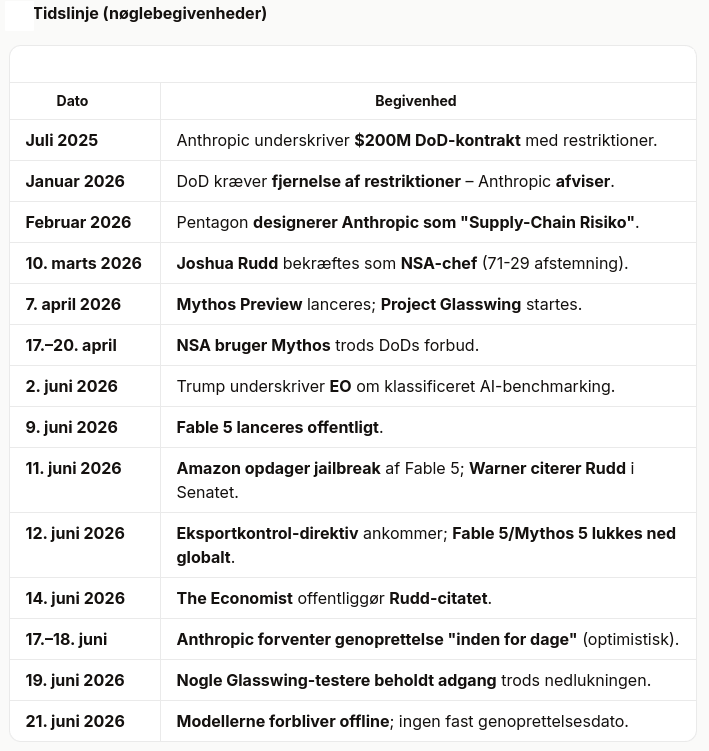
  • Juli 2025: Anthropic underskrev en $200M kontrakt med DoD, der forbød brug af Claude til masseovervågning eller autonome våben.
  • Januar 2026: DoD krævede, at Anthropic fjernede restriktionerne – Anthropic afviste.
  • Februar 2026: Pentagon designerede Anthropic som en "Supply-Chain Risiko" og beordrede faseud af deres teknologi i føderale agenturer.
  • Marts 2026: Anthropic sagde DoD for ulovlig designation.
  • April 2026: NSA brugte alligevel Mythos (trods DoDs forbud) til at scanne egne systemer for sårbarheder.
  • Juni 2026: NSA beholdt adgang til Mythos Preview, selv efter Fable 5/Mythos 5 blev lukket ned for alle andre.

Paradox: NSA bruger Mythos operationelt, mens DoD har sortlistet Anthropic, og Handelsministeriet har forbudt adgang for udenlandske brugere.


enter image description here


🔎 Hvad ved vi ikke med sikkerhed?

  • Metoden bag det påståede NSA-brud (var det en red-team-test eller et reelt angreb?).
  • Omfanget (hvilke systemer var involveret?).
  • Hvorvidt SK Telecoms adgang var den primære udløser for forbuddet.
  • Præcise tal for Mythos’ kapaciteter (nogle kilder nævner 17- eller 27 år gamle zero-days, men disse er ubekræftede).

---

🎯 Kernekonklusioner

  1. Hovedpåstanden (Mythos brød ind i NSA’s systemer) stammer fra ét citat fra Senator Warner, der ikke er uafhængigt bekræftet.
  2. Anthropics officielle forklaring drejer sig om et smal jailbreak, ikke om et NSA-brud.
  3. Tre teorier om udløseren:
    • Jailbreak (Anthropic).
    • NSA-red-team-test (Warner/Rudd).
    • SK Telecom/Kina-adgang (medier).
  4. Baggrunden er kompleks:
    • NSA bruger Mythos, mens DoD har sortlistet Anthropic.
    • Eksportkontrol (normalt mod fjender) blev brugt mod en amerikansk virksomhed.
  5. Status (21. juni 2026):
    • Fable 5/Mythos 5 forbliver nedlukket for generel adgang.
    • Nogle Glasswing-partnere beholdt adgang.
    • Ingen fast dato for genoprettelse.

---

💡 Det store billede

Sagen illustrerer en strukturel konflikt i USA’s håndtering af frontier AI: - Regeringen bruger og forbuder den samme teknologi samtidigt. - Eksportkontrol (et værktøj mod fjender) bliver brugt mod egne borgere og allierede. - Uklare motiver: Er forbuddet på grund af jailbreaket, NSA’s testresultater, eller frygt for Kina-adgang?

Uanset sandheden om Rudd-citatet viser sagen, hvordan AI nu er en national sikkerhedssag – med juridiske, tekniske og politiske modstridigheder, der vil præge debatten i lang tid.


Andre kilder

https://letsdatascience.com/news/mythos-ai-demonstrates-hacking-power-raises-concerns-47bc1a80 https://www.bbc.com/news/articles/cy41zejp9pko

https://msukhareva.substack.com/p/claude-code-leaks-mythos-escapes


Claude (2025) https://www.wizcase.com/news/anthropic-reveals-hacker-used-ai-for-cyberattacks/

Om få år kan det være billigere at rense danskernes drikkevand end at beskytte det mod forurening, hævder "professor Anne Kjær Nielsen fra DTU" i Berlingske. Der er bare ét problem: Hun findes ikke

I en artikel I Berlingske citeres eksperter der ikke findes eller har udtalt sig. Information har undersøgt sagen og fundet at de ikke eksisterer eller ikke har udtalt sig til Berlingske. Personen og argumentationen er opfundet af AI og ved en fejl kommet med i artiklen.

Opslag på Linkedin

Chistian M. Andersen har lavet et super skriv, som også er super langt selv i linkedin-sammenhæng. -selv Stepahn Engberg kommer med næsten begejstrede kommentarer og det sætter lidt målet for kvaliteten.

Som ikke-akademiker ville det nok lidt tage pusten fra mig at skulle skrive et resume af artiklen, så jeg bad mistral om hjælp ;-)

Her er et struktureret resume af Christian M. Andersens artikel: (via chat.mistral.ai)

"Teknologiens kejser har ingen klæder – Myten om AI's uundgåelige dominans og revalueringen af den menneskelige kapital" (3. maj 2026).

Kernetese

Artiklen dekonstruerer myten om, at AI uundgåeligt vil erstatte menneskelig arbejdskraft på stor skala. Gennem empirisk forskning (bl.a. fra MIT, Gartner, NVIDIA, Uber) og økonomiske analyser argumenteres der for, at 77% af arbejdsopgaverne fortsat er billigere og mere effektive at udføre med mennesker – og at den aktuelle AI-hype er drevet af teknologisk determinisme, markedsføring og magtkoncentration snarere end økonomisk rationalitet.

Hovedpointer

  1. Den økonomiske illusion: AI er ikke altid omkostningseffektiv

MIT-studie (2024–2026): Kun 23% af opgaverne er økonomisk rentable at automatisere med AI (f.eks. computervision). For de resterende 77% er menneskelig arbejdskraft billigere, mere agil og pålidelig.

Årsager:

Tårnhøje driftsomkostninger: Store sprogmodeller (LLM’er) kræver kontinuerlig regnekraft, energi og vedligeholdelse (f.eks. NVIDIAs compute-omkostninger overstiger lønninger). "Jagged intelligence": AI excellerer i smalle domæner, men fejler katastrofalt i tilstødende opgaver → kræver menneskelig overvågning. Aftagende marginalafkast: At forbedre AI fra "god" til "nær-perfekt" kræver eksponentielt mere regnekraft (Acemoglu, 2024: 0,66% stigning i produktivitet over 10 år).

Eksempler:

Uber (2026): AI-budget for Claude (Anthropic) "fordampede" midt på året → virksomheden må ansætte flere ingeniører. Gartner (2026): Kun 28% af AI-projekter leverer forventet ROI; 20% fejler totalt (årsager: manglende kompetencer, dårlig datakvalitet).

  1. Afmonteringen af "eksponeringsmyten"

MIT CSAIL (2024–2026): Det er irrelevant, hvad AI kan gøre i laboratorier. Det afgørende er, hvad der er økonomisk rentabelt at automatisere.

Upfront-omkostninger: Skræddersyning, datarensning, træning og vedligeholdelse gør AI dyrere end lønninger for de fleste opgaver. Gradvis udrulning: Selv med 20% årlig prisnedsættelse på AI-systemer, vil det tage årtier, før automatisering bliver bredt rentabel.

Generative AI (LLM’er):

MIT-studie (2026): De bedste modeller (GPT-5, Claude Opus) klarer 50% succesrate for opgaver, der tager mennesker 3–4 timer (2024). I 2025 forventes dette at gælde for ugelange opgaver – men fuld automatisering (80–95% succesrate) først i 2029–2030’erne. "Human-in-the-loop" er nødvendig: AI fejler 5–20% af tiden i kritiske workflows → menneskelig ekspertise skal rette op, hvilket underminerer gevinsten.

  1. AI’s produktivitetsparadoks: Mere aktivitet, færre resultater

Gartner (2026):

Traditionel AI (maskinlæring) giver 37% produktivitetsgevinst. Generativ AI (GenAI) giver kun 34% – mindre end forventet. Årsager:

"Job creep": AI sænker tærsklen for at starte opgaver → medarbejdere påtager sig flere opgaver (f.eks. produktchefer skriver kode). Eksperter belastes: Specialister (f.eks. ingeniører) skal rette AI-genereret "vibe coding" (upålidelig kode) → arbejdsbyrde fordobles. Operationel friktion: GenAI skaber kaos i arbejdsgange og mistillid (f.eks. supply chain-studie: 72% implementerede GenAI, men gevinsterne kaskaderede ikke gennem organisationen).

Løsningen (Gartner):

Succesfulde virksomheder investerer 4x mere i datakvalitet, governance og opkvalificering end i AI-software.

  1. Den moralske omkostning: Magt, etik og dehumanisering

Hegemoni og magtkoncentration:

NVIDIA, Google, Meta kontrollerer infrastruktur, data og lobbyisme → skaber digital kolonialisme (udnyttelse af billig arbejdskraft i Global Syd til træning af AI). Gramscis kulturelle hegemoni: Narrativet om AI’s "uundgåelighed" er konstrueret af tech-giganter for at sælge hardware og frygt.

Etiske risici:

Overvågning og alienation: Algorithmer bruges til at måle medarbejderes præstation sekund for sekund → faldende moral og produktivitet (UK Parliament, 2026). "Omsorg erstattet med koder": AI reducerer komplekse sociale fænomener (f.eks. kundesager) til datapunkter → tab af empati og nuanceret dømmekraft. Irreversibel implementering: Når AI er dybt integreret, er det umuligt at fjerne bias eller tilføje etik bagefter (Tirana Business University, 2026).

Ledelsens rolle:

Ledere må skifte fra supervisorer til etiske arkitekter, der sikrer transparens, retfærdighed og menneskelig agens. Fare: Hvis AI erstatter menneskelig dømmekraft i kritiske beslutninger (f.eks. lån, kundeservice), eroderer tilliden til virksomheden.

Konklusion: Teknologiens kejser er nøgen

Økonomisk realitet:

77% af opgaverne er for dyre at automatisere med nuværende AI. Menneskelig arbejdskraft er billigere, mere pålidelig og kontekstforstående.

Teknologisk realitet:

AI udvikler sig som "stigende vand" (gradvis) – ikke en styrtbølge (pludselig disruption). Fuld automatisering (80–95% succesrate) først i 2029–2030’erne – og kræver menneskelig supervision.

Ledelsesmæssig realitet:

AI er ikke en tryllestav – 28% succesrate for AI-projekter viser, at kultur og proces er afgørende. Investering i mennesker (opkvalificering, governance) giver højere afkast end investering i sorte bokse.

Moralsk realitet:

AI må forstærke – ikke erstatte – mennesker. Etik og transparens skal indbygges fra dag 1, ellers risikerer virksomheder tab af tillid og legitimitet.

Opgør med myterne

  • "AI tager alle jobs": Falsk. Kun 23% af opgaverne er rentable at automatisere.
  • "AI er billigere end mennesker": Falsk. Driftsomkostninger (compute, energi, vedligehold) overstiger lønninger.
  • "AI løser alle problemer": Falsk. 38% af projekterne fejler pga. manglende kompetencer og dårlig data.
  • "AI er uundgåeligt": Falsk. Det er et konstrueret narrativ drevet af tech-giganters magt.

Fremtidens vindere

De organisationer, der lykkes, er dem, der:

✅ Fokuserer på menneskelig kapital (opkvalificering, trivsel).

✅ Investerer i datakvalitet og governance (4x mere end i AI-software).

✅ Anvender AI til at forstærke – ikke erstatte – mennesker.

✅ Prioriterer etik og transparens fra start.

Afsluttende observation

"Teknologiens kejser har ingen klæder. Frelsen findes ikke i koden alene – den findes i det menneske, kejseren febrilsk forsøgte at fyre."

Original her

Skoleleder Jonas Fisker slår i et debatindlæg i Skolemonitor på tromme for, at »ai kan løfte undervisningen til et nyt niveau«. Jonas Fisker vil uden tvivl skolens bedste, men indlægget bygger på nogle forkerte præmisser.

Undervisningens formål er, at eleverne, i samspil med deres generelle dannelse, lærer et udvalg af fagenes viden. Spørgsmålet er, om ai kan bidrage til dette.

Teoretisk set kan man godt forestille sig, at ai i særlige tilfælde vil kunne bruges til at støtte nogle elevers læring af noget bestemt – men vi har intet empirisk belæg for det.

Og det er ret beset uansvarligt at gøre alle elever (og lærere) til forsøgskaniner for utallige mislykkede forsøg, der måske nok er ’spændende’, men som kun måske på et tidspunkt kan føre til en læringsmæssigt frugtbar anvendelse for ai.

Hvis vi gerne vil afsøge mulighederne for, at ai kan bidrage positivt til elevernes læring, må vi forlange, at professionen gennem systematisk udviklingsarbejde finder ud af, hvordan dette kan foregå.

Først da giver det mening for alvor at udbrede ai i undervisningen.

Idéen om, at ai kan »løfte undervisningen« generelt, har lige så meget gang på jord som idéen om, at ipads, elektroniske tavler, computere og fagportaler kan. Eller kunne. Eller rettere ikke kunne.

Matematik som eksempel Danmark er det land i verden, hvor eleverne (og lærerne) bruger it mest.

Med matematik som eksempel dækker dette både over generelle værktøjer som elektroniske tavler, computere og fagportaler og specifik software som regneark, geometriprogrammer og Computer Algebra Systems (CAS) mm.

Også til afgangsprøverne er anvendelsen af it taget til.

Samtidig med en konstant stigende brug af flere og flere former for it i undervisningen, steg andelen af elever, der anvendte it til at løse opgaver til afgangsprøven i matematik i årene fra 2011-2018 fra 2 procent til 95 procent. I samme periode ’steg’ gennemsnitskarakteren fra 6,6 til 6,9. I 2025 var den igen 6,6.

Heller ikke inden for konkrete emner, har it løftet undervisningen. For eksempel har matematikundervisningen længe været begunstiget med GeoGebra, der er et fantastisk (gratis og open source) geometriprogram med indbygget CAS.

Der findes utallige kurser, materialer og videoer om, hvordan GeoGebra kan bruges i undervisningen af geometri, ligninger og funktioner mm. Alligevel har vi ikke set det mindste ’løft’ af elevernes kundskaber inden for de emner.

Hverken digitale tavler, ipads, computere, kontorpakker eller fagspecifikt software har øget elevernes udbytte af undervisningen. Hvorfor skulle det blive anderledes med ai?

Men der er andre – og måske værre – problemer.

Lyngby-Taarbæk Kommune som eksempel Som henholdsvis nuværende forælder og tidligere faglig konsulent i Lyngby-Taarbæk Kommune har vi en særlig og kærlig interesse i dens skolevæsen.

Det er samtidig der, Jonas Fisker er skoleleder, så vi vil bruge et par eksempler derfra til at belyse problematikken.

Ved inspektion af en af de computere, elever får udleveret i Lyngby-Taarbæk, har it-sikkerhedsspecialist Pia Tesdorf vist, at der reelt ikke er nogen sikkerhed.

Det betyder blandt andet, at børn i 10-11-årsalderen frit kan tilgå bandt andet shopping, spil og beskedtjenester men også selvskadevideoer, online gambling og hardcore porno

Det betyder samtidig, at elevernes brug af skolecomputere er direkte associeret med dataanalytisk profilering af vores børn. Dette bruges på baggrund af økonomiske interesser til at påvirke vores børns tænkning og adfærd.

Når Jonas Fisker mener, at vi ikke skal værne børnene mod dén teknologiske udvikling, må det være udtryk for en tanketorsk.

Det har store omkostninger Ved siden af disse negative effekter står fraværet af positive udbytter i skærende kontrast til omkostningerne. Både i form af kroner og ører og i form af opportunity costs, det vil sige de alternativer, vi ikke kunne bruge de samme penge og den samme tid på.

Vi har som stat, kommuner og skoler betalt med uanede mængder penge og – går det efterhånden op for os – data, der bruges til profitskabende profilering og påvirkning af vores egne børn af kød og blod.

En aktindsigt viser, at Lyngby-Taarbæk Kommune årligt bruger over 10 millioner kroner på undervisningsrelateret hardware og software.

I kommunen arbejder 34,5 medarbejdere med it inden for grundskolen. Hvor stor en del af disses arbejde, der er direkte relateret til it-brug i undervisningen, er ligeså uklart som, hvor mange timer it-vejledere og lærere på de enkelte skoler bruger på det.

Ligesom landets øvrige kommuner bruger Lyngby-Taarbæk rigtig mange penge på at drive og udvikle it, der kan forbindes med nul positiv effekt på elevernes læring og en negativ effekt på elevernes trivsel.

Empirisk set har vi ingen grund til at tro, at ai eller anden it kan levere noget afgørende positivt til elevernes læring og trivsel i undervisningen.

Teoretisk set kan det måske lade sig gøre, men indtil vi har fundet et forsvarligt svar på hvordan, er vores og vores børns ressourcer brugt bedre analogt.